|
| By: Tony Cook |
Delgado Community College’s West Bank Campus is the only public institution of higher learning west of the Mississippi River in the New Orleans area. The original site of the 13.7-acre campus beside the river in Algiers was acquired in 1967 as surplus U.S. Navy property in a cooperative endeavor with Touro Hospital, LSU Medical School, the Archdiocese of New Orleans and the Orleans Parish School Board.
 |
| Undated archival photo of Building 1 |
 |
Aerial map of the West Bank Campus shows the four main structures and the green space
that give the campus a quiet, safe and collegiate atmosphere. |
The campus achieved an enrollment of about 500 in its first two years of operation. A devastating fire that destroyed the original building, and lack of financial resources, forced the West Bank Campus to close in 1970.
 |
| Building 2, September 2012 |
The campus reopened in 1974 with 750 students attending classes in a new
one-story building at 2600 General Meyer Ave., adjacent to the U.S.
Navy base that is now being redeveloped as Federal City. That building,
now called Building 1, was supplemented in 1979 by a new technical
laboratory building housing Art Department facilities and faculty
offices as well as automotive and welding shops.
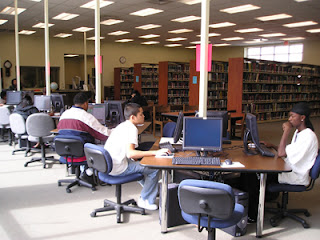 |
| Students at work in the newly expanded West Bank Campus Library, March 2005 |
Col. Floyd M. Long was executive dean of the West Bank Campus during
this rebuilding period. More than half of the 1,800 students at the West
Bank Campus in 1979 were enrolled in arts and sciences and business
classes. Two other divisions, occupational technologies and engineering,
offered the rest of the curriculum at the West Bank Campus, where more
than half of the courses met at night.
 |
Larocca Hall, July 2008. Designed by Ehlinger & Associates, the 34,195-sq. -ft building
was completed in November 1999 at a cost of $4,134,000 |
Dr. Lester Adelsberg, currently Dean of the Communication Division and Professor of English, began his Delgado career in 1974 as an adjunct instructor at the new West Bank Campus. The first year at the campus was a whirlwind of activity, he recalled. “We expected 350 students to enroll that fall semester, and 750 showed up,” he said. Hired to teach five classes, Adelsberg found himself teaching nine, some with close to 40 students. Instructors shared the classrooms. While one instructor delivered a lecture, another used the same room for individual instruction of students. A corridor on the Navy base next door was used as a classroom.
 |
| West entrance of Building 1, September 2012 |
According to Adelsberg, the demand for classes at the West Bank Campus
in the 1970s arose largely from the influx of personnel associated with
the Navy base and oil companies, which were experiencing boom years and
bringing many out-of-towners to live in Algiers and other West Bank
communities. Those newcomers were familiar with community colleges, and
students from those families were well prepared for college-level
work—as were local students from area public schools at the time,
Adelsberg explained, calling the mix “an ideal student constituency.”
The
mid-1970s faculty at the campus was “cosmopolitan,” said Adelsberg.
Many were people who had taught at higher education institutions in
other states. They thrived on teaching students who recognized the
quality and breadth of instruction available on the campus in its early
years.
 |
| Oaks behind Building 1 provide shade with scenery and make the campus feel peaceful |
The leader of the West Bank Campus, Col. Long, was “concerned about students, solicitous of the faculty and responsive to the community—a gentleman.” said Adelsberg. From the beginning, the campus placed strong emphasis on the availability of college-credit courses as well as courses that taught vocational or technical skills. Although the vocational, technical and business courses were the ones most needed to educate the oil industry workforce, the liberal arts and humanities classes thrived alongside them. “The community college recognizes that an enlightened citizenry is a necessity for workforce development,” Adelsberg said. Also, industry is drawn to communities that have strong educational institutions.
 |
| The West Bank Campus offers a quiet, contemplative environment for study |
When the oil boom ended in the 1980s, vocational and technical education was de-emphasized at the West Bank Campus. The electronics, motor vehicle repair and welding programs closed. Still, the campus provided educational opportunity for its community. West Bank high school students continued using the Delgado campus as a stepping-stone to senior college or careers. Adult learners recognized the value of its offerings as well. The campus—like all Delgado campuses, sites and instructional centers—is fully accredited by the Southern Association of Colleges and Schools.
Since then, Delgado’s West Bank Campus has grown dramatically, enlarging its vocational and technical building, Building 2, to include more classrooms, ceramics and science labs and a physical fitness center. Larocca Hall was completed in November 1999 for just over $4 million and added 15 classrooms, a state-of-the-art computer lab and multi-tiered lecture hall, student services area and faculty offices. It was named in honor of Dr. Henry Andrew LaRocca (1908-1957), a physician who was devoted to the well being of West Bank residents.
 |
| Riverside view of Larocca Hall, September 2012 |
The West Bank Campus has plenty to offer its students and community.
Currently, about 3,000 students choose from degree and certificate
programs offered in the Communication, Arts and Humanities, Business and
Technology and Allied Health Divisions at the West Bank Campus.
Professional advisors and counselors help students plan their goals and
achieve them, giving assistance to veterans and students with special
needs as well. There are Learning Resources Centers for English and
math, and the campus library provides access to a wide variety of
published and electronic books and other learning and research tools.
Intramural sports enable students to burn off excess energy, while an
active Student Government Association plans and coordinates student
activities and programs.
The student body at the West Bank Campus
reflects the diversity of its urban setting, just as Delgado’s
91-year-old City Park Campus does on the opposite bank of the
Mississippi River. More than two dozen West Bank Campus students are
participating in Delgado’s current Student Success public relations and
marketing initiative. Their faces are those of a city and suburbs where
multiculturalism has long been a way of life and a defining quality of
the region's character.
 |
| Liberal Arts Program Day at the West Bank Campus in Fall 2011 attracted hundreds of students who received information and participated in activities sponsored by campus programs and departments |
Among the most popular programs at the
West Bank Campus are Business Administration, Business and Management,
Care and Development of Young Children, Criminal Justice, Fine Arts,
General Education, General Science, Pre-Nursing and Pre-Allied Health.
Over 50 program areas are available, including the following that can be
completed entirely at the West Bank Campus: Accounting certificate,
Business Administration degree, Business and Management degree, Care and
Development of Young Children degree, Computer Aided Design and
Drafting certificate, Criminal Justice degree, Fine Arts degree,
Louisiana Arts transfer degree, Louisiana Science transfer degree and
Massage Therapist degree and certificate.
 |
| In March 2012, West Bank Campus Criminal Justice and Political Science students met with Orleans Parish District Attorney Leon A. Cannizzaro Jr. in Larocca Hall |
The West Bank Campus of Delgado Community College is an integral part of its community, and has been so since its inception 45 years ago. In August and September 2012, Delgado’s Chancellor, Dr. Monty Sullivan, visited with students, faculty and staff at the campus to learn about their plans and concerns, and to share information with them. There is unmet demand for the educational programs offered at the West Bank Campus, Sullivan said, so the challenge for the future is to expand capacity and to grow while continuing to meet workforce needs. Why not imagine a 10,000-student West Bank Campus in the future? The West Bank Campus is a vital community center for education that is beginning to write a new chapter in its long history of providing educational opportunity.
 |
| West Bank Campus students were greeted on their return for fall classes in August 2012. From left: Larissa Littleton-Steib, West Bank Campus Executive Dean; Chloe Weaver, SGA Senator, Respiratory Therapy; Henid Hassan, SGA Executive Secretary, Pharmacy; Ariael Oliver, SGA Vice President, Media Arts; John Johnson, SGA President, Business Administration; Dr. Monty Sullivan, Delgado Chancellor. |